
Sculptures
The triumphal cross of the cathedral of Nevers
Object: Triumphal cross, polychrome wood (end of the 12th, beginning of the 13th c.)Location: Nevers cathedral, Nièvre (F)
Project Supervisor: DRAC Bourgogne Franche-Comté
Treatment: stratigraphic study and analyses
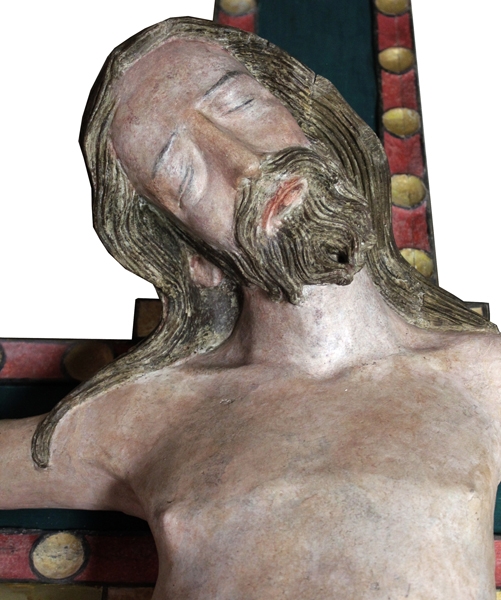
The large polychrome wooden cross preserved in the Saint-Cyr et Sainte-Julitte cathedral in Nevers consists of an oak support and a real-life walnut Christ.
During the bombing in July 1944 that ravaged the cathedral, the triumphal cross was badly damaged. At the end of the rebuilding of the choir, the work was restored and put on display on a modern cross in front of the choir. The sculpture suffered a new fall in 2015. While falling, the right arm was detached from the body of the statue, many plaster fillings were detached and cracks appeared on the complexions of the thorax. The conservation of the work was preceded by a phase of technical study. Micro-stratigraphic, taxonomic and radiometric analyses and the dendrochronology of the cross were carried out. This allowed to collect new data and to specify the dating of the sculpture and the cross.
The dendrochronology of the cross of Nevers, thanks to the ring dated 1122, anticipates the creation of the triumphal cross by locating it after 1150. This new data and the comparison with radiocarbon dating place the elaboration of the work in the last quarter of the 12th century, or around the year 1200, while confirming the contemporaneousness of the cross with the sculpture.
The quality of the triumphal cross of Nevers is highlighted even more by this dating which testifies to the richness of the formal contributions in Burgundy in the 12th century.
The classical forms of the folds of the loincloth, the naturalism of the anatomy and the face depend on the sculpture sites of the great cathedrals of the second half of the 12th century. These innovations coexist with a figure of Christ in an attitude that follows the principles of his representation applied since the 10th century.
The technique of the carving of the sculpture is an early example of the practices that are commonly observed in the 13th and 14th centuries. The back cavity is deep and carved freely with the help of a gouge and no longer with a doloire or an adze. Polychrome, meanwhile, is characterized by the use of bone black and azurite blue with a drying oil as a binder. This pigment will be more used in the following centuries with, however, an aqueous binder which gives a lighter hue.